UK Online Casino Rules That Matter When Assessing Cleobetra
 Available in GB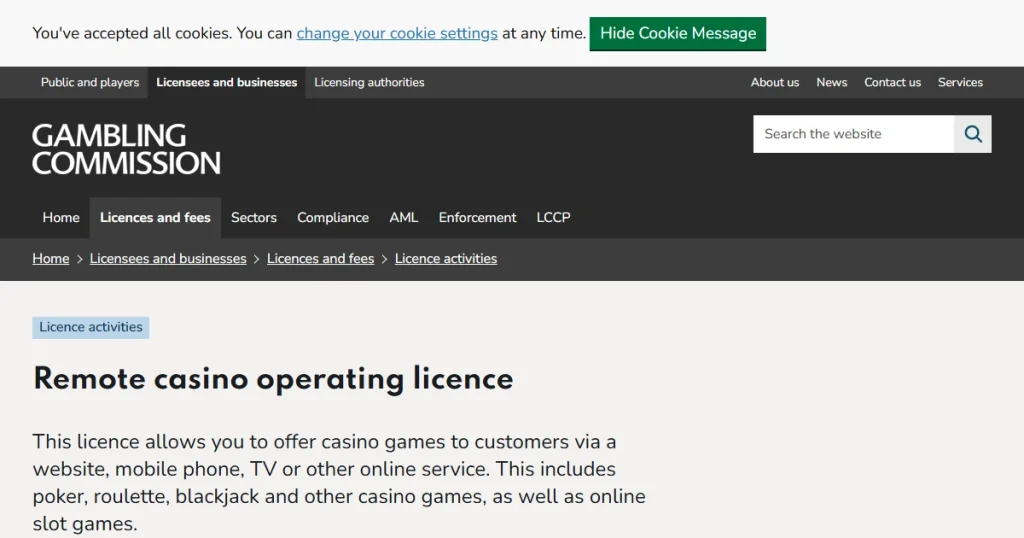
Great Britain regulation
The central rule for a Great Britain reader is straightforward: a remote operator providing gambling facilities to consumers in England, Scotland or Wales needs the appropriate Gambling Commission licence, even if the business is based abroad. Those UKGC rules are market requirements for licensed operators, not protections that can automatically be attached to Cleobetra. This project has no positive UKGC register hit for Cleobetra or NovaForge Ltd, so it does not claim UKGC coverage, GAMSTOP participation or any UKGC-mandated protection for a Cleobetra account. The sections below explain the Great Britain standards a reader can use as a comparison point, including credit-card restrictions, slot stake limits, bonus rules, vulnerability checks and the deposit-limit change scheduled for 30 September 2026.
Territorial scope
Table of Contents
- UKGC casino rules are mainly a Great Britain framework, not a single UK-wide gambling code
- The local regulator check comes before feature comparisons
- GAMSTOP, credit-card rules and self-exclusion are tied to the licensed market
- Great Britain now has age-banded maximum stakes for online slots
- UKGC licensees face a 10x wagering cap and cannot mix product types inside one incentive
- Financial vulnerability checks are already live, while broader risk assessments are moving toward staged implementation
- The new deposit-limit definition is scheduled, but not yet effective on this project’s date
- Ordinary betting and gambling winnings are generally outside UK trading income
- Which Great Britain rules should a Cleobetra reader actually compare?
- Regulation and account acceptance are related but not identical questions
- Great Britain regulatory and tax references
- The UK rules that change how Cleobetra should be assessed
- Recommend
UKGC casino rules are mainly a Great Britain framework, not a single UK-wide gambling code
The Gambling Commission’s core jurisdiction under the Gambling Act 2005 covers Great Britain: England, Scotland and Wales. Northern Ireland has separate gambling arrangements under its own legislation for most gambling activity. This distinction matters because review sites often use “UK” as shorthand even when the rule being described is specifically a Great Britain rule.
The Commission’s current remote casino guidance says that an operator needs a Gambling Commission licence if it provides online gambling facilities to consumers in Great Britain, regardless of where the business is based. The rule is therefore based on the market being served, not simply the company’s registered office. A foreign licence does not replace the Great Britain operating licence when the operator is serving Great Britain consumers.
Northern Ireland requires more careful wording. The Gambling Commission states that it does not regulate gambling activity there under the same core Gambling Act 2005 framework, although there are specific remote-advertising and equipment-related situations that can still create UKGC licence requirements. This page therefore avoids giving a blanket Northern Ireland legal answer and uses “Great Britain” where UKGC operating rules are the point.
Licence test
The local regulator check comes before feature comparisons
A casino can have thousands of games, fast navigation and attractive promotions while still failing the local licensing test. For Great Britain readers, the regulator’s own register is the appropriate licence check, while the full Cleobetra review covers the product itself. That is why the Cleobetra trust and licence page treats the current UKGC register outcome as a separate evidence category rather than inferring authorisation from Cleobetra’s offshore licence or website availability.
The absence of a positive local licence check also changes how other protections should be described. Rules such as GAMSTOP participation, the credit-card ban, slot stake limits and UKGC bonus restrictions apply to licensees in scope. They are not generic internet-wide standards that can simply be pasted onto any offshore casino page.
Player protections
GAMSTOP, credit-card rules and self-exclusion are tied to the licensed market
Remote licensees in scope must participate in the national online multi-operator self-exclusion system associated with GAMSTOP. The purpose of a multi-operator scheme is different from a casino’s own account-level self-exclusion. A user can make one exclusion request that applies across participating online operators, rather than contacting each participating business separately.
Cleobetra has its own responsible-gambling page and account-level self-exclusion route, but that is not evidence of GAMSTOP membership. Because this project does not have a positive UKGC register record for Cleobetra, it does not state that a Cleobetra account receives GAMSTOP coverage. Readers who rely on multi-operator exclusion should verify local licence status rather than assuming that any responsible-gambling page provides the same protection.
Great Britain also prohibits licensed online casino and betting operators from accepting credit-card payments for gambling. The Gambling Commission says the ban includes payments routed through e-wallets where the wallet balance was funded by a credit card. That market rule is relevant when comparing cashier standards, but it should not be misreported as a verified Cleobetra-specific cashier feature. The Cleobetra payment methods page therefore keeps global payment evidence separate from what is available to a Great Britain account.
Online slots
Great Britain now has age-banded maximum stakes for online slots
The online slot stake limits introduced in 2025 remain in force in 2026. The maximum is £5 per game cycle for customers aged 25 or over and £2 per game cycle for adults aged 18 to 24. The £5 limit went live on 9 April 2025 and the £2 under-25 limit on 21 May 2025.
The rule applies to online slots under remote casino licences, not roulette or blackjack. That product boundary matters when comparing a casino interface.
These figures are useful as a Great Britain benchmark, but this site does not claim that Cleobetra implements them. Without a verified UKGC licence record, applying the rule directly to Cleobetra would turn a market-standard comparison into an unsupported operator claim.
Promotions
UKGC licensees face a 10x wagering cap and cannot mix product types inside one incentive
From 19 January 2026, the Gambling Commission’s revised socially responsible incentive rules cap wagering requirements on bonus funds at 10 times for licensees in scope. The same package of changes prohibits mixing more than one gambling product type inside the same incentive. A single promotion should not, for example, require a customer to engage with casino and betting products together as one combined qualifying mechanism.
This makes bonus comparison easier for a Great Britain reader because the licence condition limits how complex a UKGC-regulated promotion can become. It also creates a useful contrast with global offers that may use different rollover structures. The Cleobetra bonuses page records Cleobetra’s current global promotion terms where they can be verified, but it does not claim that UKGC’s 10x rule governs those offers.
A global offer can be described as Cleobetra’s current offer, while the UKGC cap is the Great Britain licensed-market standard. They become the same legal requirement only if the operator is established as a licensee in scope.
Financial safeguards
Financial vulnerability checks are already live, while broader risk assessments are moving toward staged implementation
For remote licensees in scope, the current financial vulnerability rule requires a light-touch check when deposits minus withdrawals exceed £150 in a rolling 30-day period. The Gambling Commission describes these checks as using customer-specific public-record information such as bankruptcy orders and certain court or debt records. The regulatory requirement is not the same thing as demanding payslips or bank statements from every customer who reaches £150.
The Commission has separately decided to proceed with Financial Risk Assessments for higher-spending customers in stages. In its July 2026 update, it said Stage 1 would target unusually high spend, with initial thresholds of more than £5,000 net deposits in a rolling 24 hours for customers aged 25 or over and £2,500 for under-25s, while the formal start date would follow further implementation work. The Commission also described lower thresholds for the eventual final stage. Because the rollout timetable was still being finalised on the project date, this page does not present Financial Risk Assessments as though the full final-stage system were already universally live.
This distinction is important because “affordability checks” is often used as a loose label for several different policies. The current £150 financial vulnerability rule is live. Financial Risk Assessments are a separate, higher-spend framework being introduced in stages. Treating them as one identical check would be inaccurate.
30 September 2026
The new deposit-limit definition is scheduled, but not yet effective on this project’s date
The Gambling Commission has published new Remote Gambling and Software Technical Standards wording due to take effect on 30 September 2026. The revised rule requires customers to have easily accessible facilities to set financial limits from registration and requires a prompt to set a limit during registration or at the first deposit or payment point.
The date matters. This guide was generated on 13 September 2026, so the 30 September rule is still future-dated. It should be described as scheduled rather than already operational. If the page is published or refreshed on or after 30 September 2026, the status should be rechecked against the regulator’s live technical standards before saying that the rule has entered into force.
That freshness discipline prevents a common legal-content failure: copying a future implementation date into an article and later leaving the wording unchanged after the date passes. Regulatory pages should identify both the rule and its effective date.
Tax treatment
Ordinary betting and gambling winnings are generally outside UK trading income
HMRC’s current Business Income Manual states that betting and gambling, as such, do not constitute trading and that a mere punter is not normally carrying on a taxable trade. It also identifies gambling winnings from wagers and bets as outside the miscellaneous income charge. That supports the usual practical summary that ordinary players are generally not taxed on gambling winnings in the same way that a business is taxed on trading profits.
This is not blanket personal tax advice. Unusual facts can change the analysis, but HMRC does not normally treat routine betting or gambling wins as taxable trading income simply because someone wins consistently.
Practical comparison
Which Great Britain rules should a Cleobetra reader actually compare?
| Great Britain rule or standard | Current position | How to use it when assessing Cleobetra |
|---|---|---|
| Remote operating licence | Required to provide remote gambling facilities to Great Britain consumers. | Check the UKGC register first; do not infer local authorisation from an offshore licence. |
| GAMSTOP | Remote licensees in scope must participate in multi-operator self-exclusion. | Do not assume Cleobetra participates without verified UKGC licensing. |
| Credit cards | Licensed online casino and betting operators cannot accept credit-card gambling payments. | Use as a local benchmark, not as a verified Cleobetra cashier rule. |
| Online slot stakes | £5 for age 25+ and £2 for age 18-24 per game cycle. | Applies to licensed online slots, not every casino product. |
| Bonus wagering | Maximum 10x bonus funds for licensees in scope from 19 January 2026. | Compare with Cleobetra global terms without claiming UKGC rules govern them. |
| Financial vulnerability check | Triggered above £150 net deposits in a rolling 30-day period for remote licensees in scope. | Do not misdescribe this as universal document-based affordability checking. |
| Deposit-limit technical change | Scheduled for 30 September 2026. | Recheck after the effective date before switching from future to current tense. |
Availability boundary
Regulation and account acceptance are related but not identical questions
A reader can reach a website from Great Britain without that proving the operator accepts Great Britain registrations. Likewise, a global page can display bonuses or payment methods without proving that a British account receives them. The Cleobetra UK access guide keeps those operational questions separate because current independent sources consistently list the United Kingdom as restricted, while the visible official Cleobetra help content confirms only that restricted jurisdictions exist without exposing the UK entry itself.
That is why this page does not use UK regulation to fill product gaps. If a UKGC rule says licensed casinos cannot accept credit cards, it tells us what a licensee in the Great Britain market must do. It does not prove which payment methods Cleobetra presents to a British user. If UKGC licensees must participate in GAMSTOP, that describes the licensed market. It does not prove Cleobetra is inside the scheme.
The cleanest assessment therefore separates three layers: Cleobetra’s verified global product, evidence about Great Britain account availability, and the regulatory duties placed on UKGC licensees. Combining those layers produces confident-sounding but inaccurate claims.
Primary sources checked 13 September 2026
Great Britain regulatory and tax references
Regulatory lens
The UK rules that change how Cleobetra should be assessed
Great Britain gives readers a concrete benchmark: local remote licensing, multi-operator self-exclusion, a credit-card ban, age-banded slot stake limits, tighter bonus rules and financial safeguards. Those protections should be attributed only to operators actually inside the UKGC framework. Cleobetra’s global product can be reviewed separately, but this project has no positive UKGC register evidence that allows those Great Britain protections to be attached to the brand. The most reliable approach is therefore to compare Cleobetra against the local standard without pretending the standard is already a verified Cleobetra obligation.